
• Skip to primary navigation
  • Skip to main content
  • Skip to primary sidebar

Reuel Payne - Weight Training

Making Good Health Your Priority

  • HOME
  • About

The Science of Sarcopenia: Why We Lose Muscle as We Age and How Strength Training Fights Back

February 17, 2026 by Reuel Payne

As we get older, many of us notice that everyday tasks such as carrying groceries, climbing stairs, or even standing up from a chair start to feel harder. This isn’t just “getting old.” It’s often the result of sarcopenia, the natural decline in muscle mass and strength that comes with age.

What Is Sarcopenia?


Sarcopenia is the gradual loss of muscle tissue and function. It usually begins in your 30s or 40s and speeds up after age 60. By the time people reach their 80s, as many as half may experience significant muscle loss. Weak muscles don’t just affect strength, they also slow metabolism, reduce balance, and increase the risk of falls and frailty.

Why Does Muscle Decline?


The main culprits are hormonal changes and reduced activity levels. Two key hormones play a big role:

Growth Hormone (GH): This hormone helps repair and build muscle tissue. As we age, GH levels drop, meaning our muscles don’t recover or grow as easily.

Testosterone: Known as the “strength hormone,” testosterone supports muscle protein synthesis. Men experience a steady decline in testosterone with age, and women also see hormonal changes that affect muscle tone.

When these hormones decrease, the body becomes less efficient at maintaining muscle, even if diet and activity remain the same.
How Strength Training Helps


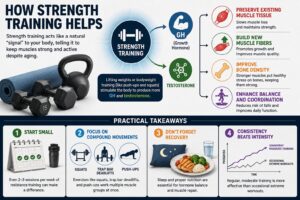
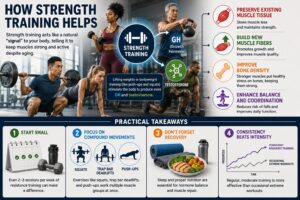
Here’s the good news: strength training directly combats sarcopenia. Lifting weights, or even bodyweight training (like push-ups and squats) stimulate the body to produce more GH and testosterone. This hormonal boost helps:

Preserve existing muscle tissue

Build new muscle fibers

Improve bone density

Enhance balance and coordination

In short, strength training acts like a natural “signal” to your body, telling it to keep muscles strong and active despite aging.


Practical Takeaways


Start small: Even 2–3 sessions per week of resistance training in a gym can make a difference.

Focus on compound movements: Exercises like squats, trap bar deadlifts, and push-ups work multiple muscle groups at once.

Don’t forget recovery: Sleep and proper nutrition are essential for hormone balance and muscle repair.

Consistency beats intensity: Regular, moderate training is more effective than occasional extreme workouts.
Bottom Line


Sarcopenia is a natural part of aging, but it doesn’t have to define your later years. By understanding the hormonal shifts behind muscle loss and using strength training to counteract them, you can stay strong, mobile, and independent well into old age.


Follow on Facebook and Instagram

Filed Under: Strength Training Tagged With: Aging, balance and coordination, bone density, compound movements, frailty prevention, growth hormone, healthy aging, hormonal changes, metabolism slowdown, muscle loss, muscle protein synthesis, resistance exercise, Sarcopenia, Strength Training, testosterone decline

Primary Sidebar

Recent Posts

  • The Stacking Problem: Why You Can’t Trust Most Supplement Reviews
  • The Science of Sarcopenia: Why We Lose Muscle as We Age and How Strength Training Fights Back
  • Creatine: The Powerhouse Supplement
  • Fitness Over 40: Stay Strong and Healthy
  • Creatine for Women: More Than Just a Gym Supplement

Recent Comments

  • Branched-Chain Amino Acids (BCAAs): Maximizing Recovery and Muscle Health - Reuel Payne - Weight Training on The Unspoken Advantage: Why Experience Matters in Fitness
  • 3 Common Strength Training Myths - Reuel Payne - Weight Training on Functional Independence: The Power of Strength Training for Seniors
  • 3 Common Strength Training Myths - Reuel Payne - Weight Training on Is Reversing Type 2 Diabetes Possible?
  • Important Things To Know About Strength Training - Reuel Payne - Weight Training on Injury Prevention in the Gym: Essential Safety Tips
  • Important Things To Know About Strength Training - Reuel Payne - Weight Training on Exercise: A Powerful Tool for Mental Health

Archives

  • June 2026
  • February 2026
  • September 2025
  • June 2025
  • May 2025
  • February 2025
  • November 2024
  • August 2024
  • June 2024
  • May 2024
  • April 2024
  • September 2023
  • August 2023
  • July 2023
  • April 2023
  • January 2023
  • December 2022
  • October 2022
  • August 2022
  • July 2022
  • September 2020
  • August 2020
  • June 2020
  • May 2020
  • April 2020
  • February 2020
  • January 2020
  • August 2019
  • July 2019
  • March 2019
  • October 2018
  • December 2017
  • June 2017
  • May 2017
  • April 2017

Categories

  • Amino Acids
  • Cardio
  • Cardiovascular Exercise
  • Dietary Supplementation
  • Drugs
  • Exercise
  • Fat Loss
  • Gym Etiquette
  • Health
  • Healthy Lifestyle
  • SARMS & Peptides
  • Strength Training
  • Weight Training

Recent Posts

  • The Stacking Problem: Why You Can’t Trust Most Supplement Reviews
  • The Science of Sarcopenia: Why We Lose Muscle as We Age and How Strength Training Fights Back
  • Creatine: The Powerhouse Supplement
  • Fitness Over 40: Stay Strong and Healthy
  • Creatine for Women: More Than Just a Gym Supplement

Recent Comments

  • Branched-Chain Amino Acids (BCAAs): Maximizing Recovery and Muscle Health - Reuel Payne - Weight Training on The Unspoken Advantage: Why Experience Matters in Fitness
  • 3 Common Strength Training Myths - Reuel Payne - Weight Training on Functional Independence: The Power of Strength Training for Seniors
  • 3 Common Strength Training Myths - Reuel Payne - Weight Training on Is Reversing Type 2 Diabetes Possible?
  • Important Things To Know About Strength Training - Reuel Payne - Weight Training on Injury Prevention in the Gym: Essential Safety Tips
  • Important Things To Know About Strength Training - Reuel Payne - Weight Training on Exercise: A Powerful Tool for Mental Health

Archives

  • June 2026
  • February 2026
  • September 2025
  • June 2025
  • May 2025
  • February 2025
  • November 2024
  • August 2024
  • June 2024
  • May 2024
  • April 2024
  • September 2023
  • August 2023
  • July 2023
  • April 2023
  • January 2023
  • December 2022
  • October 2022
  • August 2022
  • July 2022
  • September 2020
  • August 2020
  • June 2020
  • May 2020
  • April 2020
  • February 2020
  • January 2020
  • August 2019
  • July 2019
  • March 2019
  • October 2018
  • December 2017
  • June 2017
  • May 2017
  • April 2017

Categories

  • Amino Acids
  • Cardio
  • Cardiovascular Exercise
  • Dietary Supplementation
  • Drugs
  • Exercise
  • Fat Loss
  • Gym Etiquette
  • Health
  • Healthy Lifestyle
  • SARMS & Peptides
  • Strength Training
  • Weight Training
Always consult with a qualified healthcare professional prior to beginning any diet or exercise program or taking any dietary supplement. The content on my website is for informational and educational purposes only and is not intended as medical advice or to replace a relationship with a qualified healthcare professional. copyright © 2026 reuelpayne.com